Hey there, fellow Amazon seller! Imagine this familiar scene: You’ve set up what seems like a solid PPC campaign, only to find your budget drained with little to show for it. Frustrating, right? Now, picture this instead: You’re checking your Seller Central dashboard, and your sales suddenly jump by 300%. This transformation is not just a stroke of luck but the result of a well-executed Amazon FBA PPC strategy. We’ve grown several FBA businesses to six figures and helped clients do the same, proving that PPC can move your products from hidden to top-ranked. For instance, we helped a client in the home goods sector reduce their ACoS by 40% within two months, which resulted in their sales doubling over the following quarter. But without the right approach, your budget can disappear as quickly as a Prime Day deal.
In 2025, Amazon’s advertising environment is increasingly competitive, with more than 2.5 million sellers competing for clicks. Nevertheless, informed FBA sellers are succeeding by leveraging Sponsored Products, Sponsored Brands, and Sponsored Displays to attract targeted traffic. Whether you are launching your first product or optimizing established campaigns, this guide provides comprehensive information on Amazon FBA PPC. It covers strategies, costs, launch plans, and a comparison to alternatives such as 3PL PPC. By the end, you will have clear steps to lower ACoS, boost conversions, and scale your business.
Continue reading for practical examples, straightforward lists, and a summary table for reference. Let us begin and ensure your advertising efforts are effective.
What is Amazon FBA PPC and How Does It Work?
If you’re wondering what Amazon FBA PPC is, you’re not alone. It’s your ticket to getting noticed on Amazon. FBA stands for Fulfilment by Amazon, and PPC means Pay-Per-Click advertising. With Amazon FBA PPC, you bid on keywords so your products show up in search results, product pages, and even on competitor listings. You only pay when someone clicks your ad, making it a cost-effective way to reach shoppers who are ready to buy.
Unlike organic SEO, which can take months to rank, PPC delivers instant traffic. For FBA sellers, it’s a game-changer because your products come with the Prime badge, signalling fast, free shipping to millions of loyal customers. This boosts conversion rates—studies show Prime-eligible items convert up to 20% higher than non-Prime ones. Entities like Sponsored Products (product-level ads) and Sponsored Brands (logo-featured banners) are key here, optimized for mobile and voice searches like “best kitchen gadgets on Amazon.”
Practical example: Say you’re selling a bamboo cutting board. You bid on “bamboo cutting board” via Sponsored Products. Your ad appears in search results, a shopper clicks, buys, and Amazon handles fulfilment—boom—sales without the hassle.
But success isn’t automatic. You need to master bidding (setting the maximum amount you’re willing to pay for each ad click), keyword selection (choosing which search terms should trigger your ads), and campaign types (the structure of your ad campaigns, like automatic or manual) to avoid high ACoS (Advertising Cost of Sales, calculated as ad spend divided by sales from ads, shown as a percentage). ACoS is your ad spend divided by ad-attributed sales, multiplied by 100 to get a percentage. Aim for under 30% to stay profitable. In 2025, with rising competition, incorporating LSI (Latent Semantic Indexing, which refers to including semantically related keywords) keywords like ‘Amazon sponsored ads optimization’ and ‘PPC bid management’ in your campaigns is crucial for relevance. To effectively find these LSI keywords, utilize tools and resources like Helium 10’s keyword explorer, which helps identify related search terms, and Amazon’s autocomplete feature, which provides insights into popular search queries. These tools will assist you in integrating relevant LSI keywords seamlessly.
Amazon FBA PPC Strategy: Building a Winning Framework
To build a strong Amazon FBA PPC strategy, you need a solid foundation. In 2025, focus on making data-driven decisions, using automation (ad management tools that automatically adjust bids and keywords), and targeting the right audience to get the best return on your investment.
Start with keyword research. Use tools like Amazon’s Search Term Report or third-party software to find high-volume, low-competition terms. For instance, instead of broad “kitchen tools,” target long-tail LSI keywords like “eco-friendly bamboo cutting board for home chefs.” These are perfect for voice searches, such as “Alexa, find sustainable cutting boards on Amazon.”
Next, structure your campaigns:
- Automatic Campaigns: Let Amazon’s algorithm match your ads to shopper searches. Great for discovery—run these first to gather data.
- Manual Campaigns: Take control with exact, phrase, and broad match types. Bid higher on precise matches for precision.
- Sponsored Brands and Displays: Build awareness with video ads or retargeting. These can reduce ACoS by 15% through better branding.
OptimisationOptimization tips:
- Monitor ACoS weekly and adjust bids. If a keyword’s ACoS exceeds 35%, negate it.
- Use dynamic bidding—Amazon’s “up and down” option adjusts bids in real-time for better ad placement. Dynamic bidding means your bid may automatically increase or decrease based on the likelihood of a sale.
- Incorporate negative keywords to avoid irrelevant traffic. Negative keywords are terms you tell Amazon to exclude, such as negating “plastic” for your bamboo product, so your ads don’t show to shoppers searching for something different.
Real-world example: One of my clients in the beauty niche launched with a $500 daily budget. By focusing on manual targeting and weekly optimizations, they dropped ACoS from 45% to 22% in two months, scaling sales to $50K/month. Remember, strategy evolves—test, analyze, repeat for sustained growth.
Incorporate entity optimization by ensuring your product listings align with Amazon’s A9 algorithm. Entity optimization means making sure your product titles, descriptions, and keywords match search intent, which the A9 algorithm uses to rank products. For voice search, phrase your text in natural language, such as “How to create an Amazon FBA PPC strategy for beginners.”
Amazon FBA PPC Cost Breakdown: What to Expect in 2025
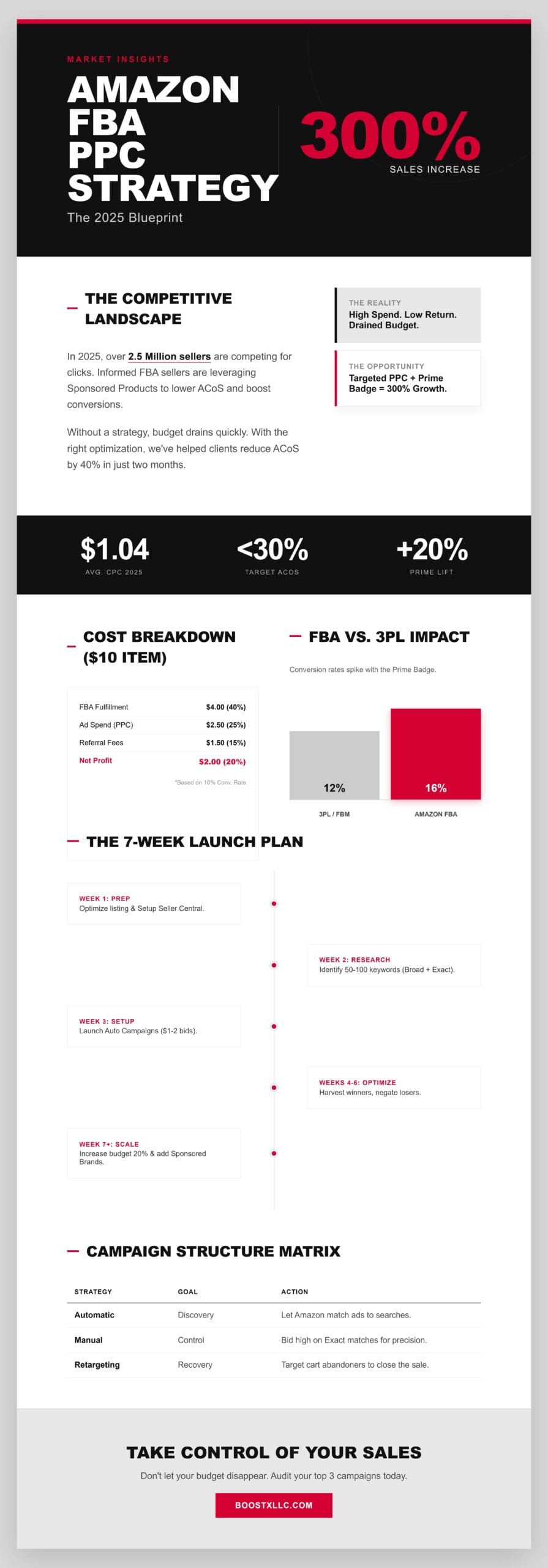
Curious about costs? Here are the basics. Amazon FBA PPC uses a Cost-Per-Click (CPC) model. You set your bids, but the actual cost depends on competition and your quality score.
For 2025, the average CPC hovers around $0.98-$1.04 overall, which is a 10% increase from last year due to increased ad demand. When compared to the 5-6% annual growth observed in the previous three years, this spike underscores a notable shift in the landscape. Additionally, for categories like Home & Kitchen, expect CPCs ranging from $0.90-$1.20 per click, with variations influenced by seasonality, notably higher during the holidays. This rate exceeds other ad platforms like Google Ads where CPCs have risen by approximately 7% yearly, highlighting the growing competitiveness of Amazon advertising.
But CPC is just the tip. Factor in ACoS for true profitability—target 20-30% for mature campaigns. Other costs include:
| Cost Component | Description | Average Estimate (2025) | Example for $10 Product |
| CPC | Cost per ad click | $0.98-$1.04 | $1.00 per click |
| ACoS | Ad spend as % of sales | 20-30% | 25% ($2.50 ad spend per sale) |
| FBA Fees | Fulfillment & storage | $3-5 per unit | $4.00 (includes shipping) |
| Referral Fees | Amazon’s cut (usually 15%) | 15% of sale | $1.50 |
| Total Ad-Related Cost | PPC + Fees | Varies | ~$7.00 (leaving $3 profit) |
This table assumes a 10% conversion rate, where conversion rate is the percentage of shoppers who buy after clicking your ad. For a deeper dive, calculate your break-even ACoS: (Profit Margin Before Ads / Selling Price) x 100. If your margin is 40% on a $20 item, break-even ACoS is 40%.
Watch out for hidden costs. Storage fees can increase for products that don’t sell quickly, and poorly managed campaigns can raise your ACoS. It’s smart to start by putting about 30% of your FBA margin toward PPC, then reduce this as your organic sales grow. In competitive categories, plan to spend $500 to $1,000 per product each month at first.
Voice search optimization: Queries like “What’s the cost of Amazon FBA PPC ads?” should lead to your content—use natural language in subheadings.
Amazon FBA PPC Launch Plan: Step-by-Step for New Products
Launching a new product? Your Amazon FBA PPC launch plan is your roadmap to ranking and reviews. Follow this 6-step process for 2025 success.
- Pre-Launch Prep (Week 1): Optimize your listing—killer images, bullet points with LSI terms like “durable bamboo cutting board,” and A+ content. Set up a Seller Central PPC account.
- Keyword Research (Week 2): Identify 50-100 keywords. Use broad for volume, exact for intent—tools like Helium 10 help here.
- Campaign Setup (Week 3): Start with auto campaigns at $1-2 bids. Budget $20-50 daily. Add a manual exact match for top keywords.
- Monitoring & Optimization (Weeks 4-6): Check Search Term Reports daily. Harvest winners (low ACoS keywords) into new campaigns; negate losers.
- Scaling (Week 7+): Increase budgets by 20% for performers. Introduce Sponsored Brands for visibility.
- Review & Adjust: Aim for 10-15 sales/day initially—track TACoS (Total ACoS) to measure overall impact.
Example: For a kitchen gadget launch, one seller spent $300 on auto campaigns in week 1, gathering 200 keywords. By week 4, manual campaigns drove 50 sales at 28% ACoS. Result? Organic rank jumped to page 1.
Incorporate entities like Amazon’s Brand Registry for enhanced ads. For voice: “How do I launch Amazon FBA PPC campaigns step by step?”
Amazon FBA PPC vs 3PL PPC: Which Fulfilment Wins?
Confused about Amazon FBA PPC vs 3PL PPC? Let’s compare. FBA (Fulfilment by Amazon) integrates seamlessly with PPC, offering Prime eligibility for better conversions. 3PL (Third-Party Logistics) is often used with FBM (Fulfilment by Merchant), where you handle shipping via external providers.
Key differences:
- Fulfilment Speed and Prime Badge: FBA gets Prime (2-day shipping), boosting click-to-buy rates by 20-30% and lowering ACoS. For instance, a brand selling electronics switched its identical SKUs from FBM to FBA and observed a conversion rate increase from 12% to 16%, resulting in a 28% rise. This change also led to a decrease in cart abandonment rates by about 15%, making FBA a more enticing choice. Meanwhile, 3PL/FBM may not qualify, leading to higher cart abandonment.
- Ad Placement & Visibility: FBA sellers often get preferential ad spots due to reliability metrics. FBM/3PL can compete but may face lower quality scores.
- Costs: FBA fees (~$3-5/unit) vs. 3PL ($1-3/unit + shipping). PPC costs are similar, but FBA’s higher conversions offset fees.
- Control: 3PL offers more inventory flexibility; FBA handles everything but charges for storage.
Example: An FBA seller in electronics saw 15% ACoS with Prime perks. Switching to 3PL/FBM? ACoS rose to 25% due to slower shipping.
Choose FBA for scale, 3PL for cost control in niches with custom shipping. Voice query: “What’s the difference between FBA and 3PL PPC on Amazon?”
Advanced Tips for Amazon FBA PPC Optimisation in 2025
To elevate your game, focus on these expert tactics:
- Bid Adjustments: Use placement modifiers—boost top-of-search by 50% for visibility.
- Audience Targeting: Retarget cart abandoners with Sponsored Display ads.
- Seasonal Scaling: Ramp up bids during Q4; reduce in off-seasons.
- Common Mistakes to Avoid: Overbidding on broad terms, ignoring negatives, or neglecting mobile optimization. To prevent overbidding, set bid caps for broad terms to maintain control over your spending. To ignore negatives, regularly update and refine your negative keyword list to avoid irrelevant clicks. Ensure your campaigns are mobile-optimized by testing ads on different devices and adjusting ad formats accordingly.
Case study: A home goods seller reduced ACoS by 30% by adding video ads and negative keywords.
LSI integration: Terms like “Amazon PPC automation tools” and “conversion rate optimization” enhance relevance.
Wrapping Up: Take Control of Your Amazon FBA PPC Today
That’s a full overview of Amazon FBA PPC that can help you grow your sales in 2025. From strategies to lower your ACoS to launch plans that build momentum, the most important thing is to keep testing and making data-driven changes. At BoostX LLC, our team of experts has helped clients reach $10K per month, and we can say that PPC is not just a cost—it’s an investment in your business growth.
Want to improve your results? Start by auditing your top three campaigns today to identify key areas for improvement. Once you’ve reviewed them, visit boostxllc.com to book a free consultation or request a complimentary email audit. We’ll dive into your setup and provide actionable insights to optimize your performance. Take action now, because your competitors are moving fast and every moment you wait could be a missed opportunity.
FAQs
How is FBA PPC different from FBM PPC?
FBA PPC leverages Amazon’s fulfilment for Prime eligibility, leading to higher conversions and potentially better ad placements due to faster shipping. FBM PPC relies on self-fulfilment, which may lack Prime perks, increasing ACoS from lower trust and slower delivery.
What is the average CPC for FBA sellers in Home & Kitchen?
In 2025, the average CPC for the Home & Kitchen category on Amazon PPC is around $1.10, varying by competition and seasonality, with peaks during holidays.
Do FBA sellers get better ad placement than FBM?
Yes, FBA sellers often receive preferential ad placements because of Prime status and fulfilment reliability, which Amazon’s algorithm favours for higher conversion potential.
How much of my FBA margin should I allocate to PPC?
Allocate 20-30% of your FBA margin to PPC, aiming for an ACoS under 30% to maintain profitability while scaling traffic.
Can the Prime badge alone reduce ACoS?
The Prime badge can indirectly reduce ACoS by boosting conversion rates up to 20-30%, as it builds buyer trust and encourages quicker purchases, lowering the effective cost per sale.