Hey, fellow Amazon entrepreneur! Picture this: You’ve poured your heart (and wallet) into sourcing that perfect product, optimized your listing with killer keywords, and hit “launch.” But crickets. No sales, no visibility in the sea of millions of products. That’s where Amazon PPC (Pay-Per-Click) comes in—like a turbo boost for your listings. But is Amazon PPC worth it, especially with rising ad costs and algorithm tweaks in 2025? Spoiler: For most sellers, yes, but only if you play it smart. In this guide, we’ll dive deep into the pros, cons, and strategies to make PPC pay off, whether you’re a newbie or scaling up. Let’s break it down so you can decide if it’s the right move for your business.
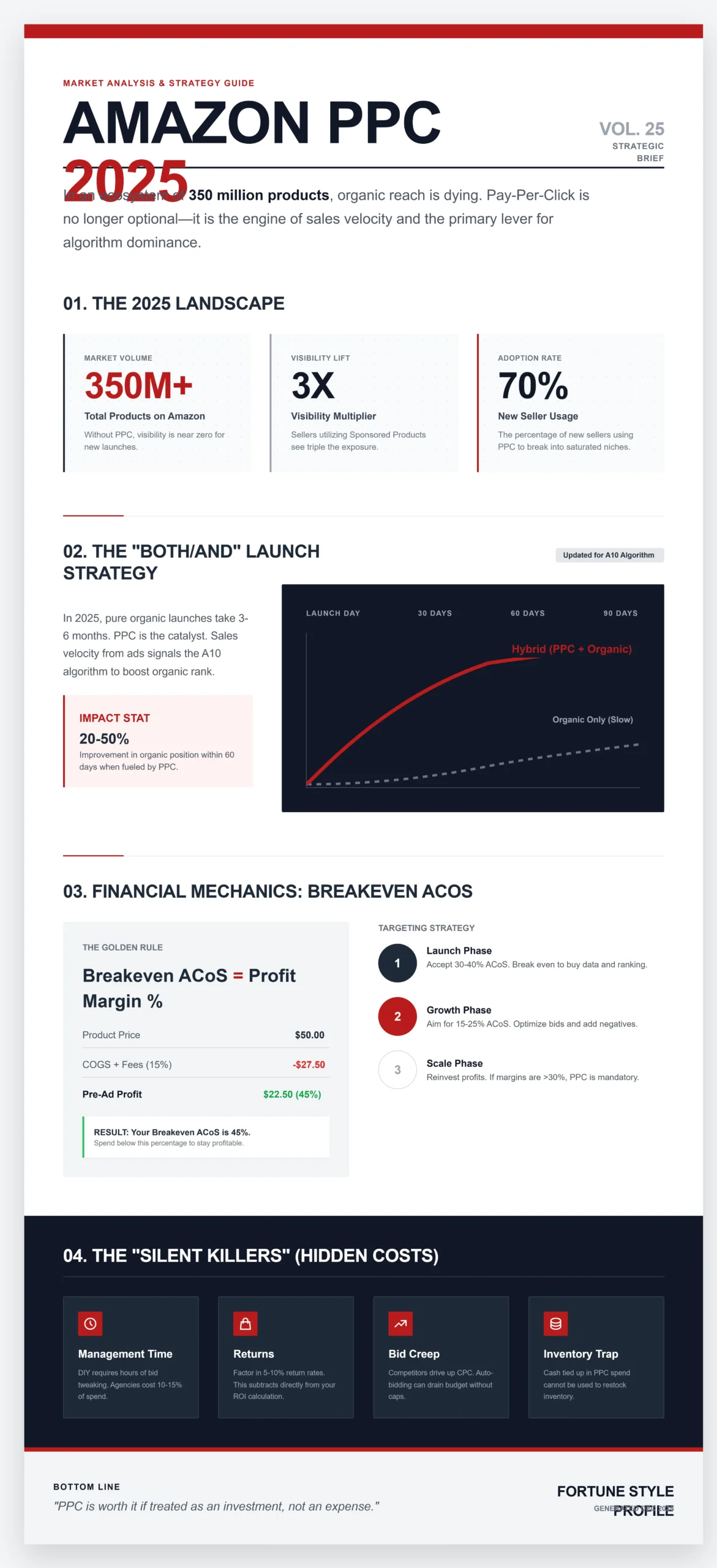
Amazon PPC, or Sponsored Products ads, lets you bid on keywords to appear at the top of search results. You only pay when someone clicks—hence “pay-per-click.” In 2025, with over 350 million products on Amazon and fiercer competition, PPC isn’t just optional; it’s often essential for getting eyes on your items. But worth it? Absolutely, if your Advertising Cost of Sales (ACoS) stays in check. Recent data shows sellers using PPC see up to 3x more visibility, leading to higher organic rankings over time. We’ll cover everything from breakeven points to hidden pitfalls, with real examples to keep it practical.
Is Amazon PPC Worth It for New Sellers?
If you’re a new seller dipping your toes into Amazon FBA in 2025, PPC can feel intimidating—like throwing money into a black hole. But hear me out: Yes, Amazon PPC is worth it for new sellers, especially when organic traffic is slow to build. Why? Because Amazon’s algorithm favors products with early sales velocity, and PPC delivers that quick win.
Take Sarah, a newbie seller launching organic skincare in 2025. Without PPC, her listings languished on page 5 of search results. She started with a modest $50 daily budget on Sponsored Products, targeting keywords like “natural face cream.” Within two weeks, she generated $1,200 in sales from $300 in ad spend—an ACoS of 25%, well below her 40% profit margin. This not only covered costs but boosted her organic rank, leading to free traffic later.
Pros for newbies:
- Instant Visibility: Skip the wait for organic SEO to kick in. PPC puts you in front of high-intent buyers searching right now.
- Data Goldmine: Use PPC insights to refine your listings—see which keywords convert and optimize accordingly.
- Scalability: Start small (think $10-20/day) and scale as you learn. Tools like Amazon’s Campaign Manager make it beginner-friendly.
- Competitive Edge: In saturated niches like electronics or beauty, PPC is how 70% of new sellers break through.
But it’s not all sunshine. If your product isn’t optimized (poor images, weak reviews), PPC can burn cash fast. Aim for a target ACoS under 30% to stay profitable—more on that later. In 2025, with AI-driven bidding, new sellers can automate optimizations, but manual tweaks are key for cost control. Bottom line: For new sellers, PPC is worth it if you treat it as an investment, not an expense.
Amazon PPC vs Organic Launch: Which is Better?
Ah, the age-old debate: Amazon PPC vs organic launch. In 2025, it’s not either/or—it’s both/and for maximum impact. Organic launches rely on SEO, reviews, and natural traffic, while PPC juices things with paid ads. Let’s compare them head-to-head.
An organic launch means optimizing your title, bullets, and backend keywords for Amazon’s A10 algorithm (updated in 2025 with more emphasis on buyer behavior). It’s free but slow—expect 3-6 months to rank well without external traffic. PPC, on the other hand, accelerates this by driving initial sales, which signals to Amazon that your product is hot, improving organic placement.
Example: Mike launched a kitchen gadget organically in early 2025. He focused on long-tail keywords like “eco-friendly bamboo cutting board” and built reviews via Vine. Sales trickled in at 5/day after a month. His buddy Lisa used PPC alongside, bidding on “bamboo cutting board” with a $100/week budget. Her sales hit 20/day in week one, and by month two, organic traffic overtook PPC as rankings soared.
Comparison Table:
| Aspect | Amazon PPC Launch | Organic Launch |
| Speed | Fast (days to weeks) | Slow (months) |
| Cost | Variable ($0.10-$6/click) | Free (but time-intensive) |
| Sustainability | Short-term boost; needs ongoing budget | Long-term; builds momentum |
| Risk | High if mismanaged (e.g., high ACoS) | Low, but harder in competitive niches |
| Best For | New products, competitive categories | Established sellers with strong SEO |
| 2025 Trend | AI bidding for efficiency | Enhanced by PPC sales velocity |
In 2025, PPC complements organic by providing the sales data Amazon craves for ranking. Studies show PPC-driven sales can improve organic position by 20-50% within 60 days . Pure organic is possible in low-competition niches, but for most, blending them yields the best ROI. Pro tip: Use PPC for launch phase (first 30-60 days), then taper as organic grows.
Using a Breakeven ACoS Calculator for Amazon PPC
Nothing kills PPC enthusiasm like a skyrocketing ACoS (Advertising Cost of Sales). ACoS measures ad spend as a percentage of ad-attributed sales—lower is better for profitability. In 2025, average ACoS hovers around 20-30%, but yours depends on margins.
The breakeven ACoS is where ad costs equal your profit margin—no loss, no gain. Formula: Breakeven ACoS = (Profit Margin %) x 100. For example, if your margin after fees is 35%, breakeven is 35%. Anything below? Profit!
Calculator Example: Say your product sells for $50, costs $20 to make/ship, and Amazon takes 15% fees ($7.50). Profit before ads: $22.50 (45% margin). Breakeven ACoS: 45%.
Breakeven ACoS Table:
| Product Price | COGS + Fees | Profit Margin | Breakeven ACoS | Target ACoS (for 20% Profit) |
| $20 | $12 | 40% | 40% | 20% |
| $50 | $30 | 40% | 40% | 20% |
| $100 | $60 | 40% | 40% | 20% |
| $20 | $15 | 25% | 25% | 5% |
| $50 | $35 | 30% | 30% | 10% |
Tools like SellerApp’s free ACoS calculator let you plug in real numbers for instant insights . For new sellers, aim for a target ACoS 10-15% below breakeven to build cushion. In 2025, factor in returns (5-10%) by subtracting them from sales in your calc
. Practical tip: Monitor weekly; if ACoS spikes over 40%, pause low-performers.
Hidden Costs of Amazon PPC You Need to Know
PPC sounds simple—bid, click, sell. But in 2025, hidden costs can sneak up and tank your profits. Beyond the obvious CPC (Cost Per Click, averaging $0.10-$6), there’s more.
First, management fees: If you outsource to agencies, expect 10-15% of ad spend plus $500-$2,000 setup DIY? Time is money—hours tweaking bids add up.
Then, opportunity costs: Money tied in PPC can’t fund inventory. Plus, “hidden” Amazon fees like storage or referral (15% on sales) compound.
Example: Tom spent $1,000 on PPC, generating $4,000 sales (25% ACoS). But after 10% returns ($400) and fees ($600), true profit? $1,000 – ad spend = break even. Ouch!
Bullet-proof your budget:
- Bid Creep: Competitors drive up costs; use auto-bidding wisely.
- Irrelevant Clicks: Broad match wastes money—add negatives early.
- Data Overload: Free tools help, but premium software ($50/month) uncovers insights.
- Seasonal Spikes: Q4 2025 costs rise 20-30%; budget accordingly.
- Long-Term Drain: Over-reliance ignores organic growth.
In 2025, AI tools minimize these, but vigilance is key. Track true ROI: (Sales – All Costs) / Ad Spend x 100.
Frequently Asked Questions About Amazon PPC
At What Profit Margin Does Amazon PPC Become Mandatory?
PPC isn’t “mandatory” at any margin, but if your pre-ad profit is below 20%, it’s risky—hidden costs could erase gains. For margins 30%+, it’s highly recommended in competitive niches. At 40%+, it’s a no-brainer for scaling.
How Do I Calculate True ROI Including Returns and Fees?
True ROI = [(PPC Sales – Returns – Fees – Ad Spend – COGS) / Ad Spend] x 100. Example: $5,000 sales, 10% returns ($500), 15% fees ($750), $1,000 ad spend, $2,000 COGS. Net: $5,000 – $500 – $750 – $1,000 – $2,000 = $750 profit. ROI: ($750 / $1,000) x 100 = 75%Use tools like Seller Labs for automation.
Is PPC Still Worth It with a 30% ACoS Target?
Yes, if your breakeven is 40%+ (common for high-margin items). A 30% ACoS means you’re profitable, especially if PPC boosts organic sales. In 2025, aim lower (15-25%) for better ROI, but 30% works for launches
Can I Rank Organically Without PPC in 2025?
Possible, but tough in crowded categories. Focus on stellar SEO, reviews, and external traffic (social media). However, PPC accelerates ranking by 20-50% via sales velocity. In low-competition niches, yes; otherwise, hybrid is best.
How Much Should I Budget for PPC in My First 60 Days?
Start with $10-50/day ($600-3,000 total), scaling based on performance. For a $20-50 product, allocate 10-20% of projected sales. In 2025, test with $500 minimum to gather data, then optimizeMonitor ACoS weekly.
There you have it—Amazon PPC demystified for 2025. It’s worth the investment if you strategize, track metrics, and blend with organic efforts. Ready to supercharge your sales? Sign up for our free Amazon seller newsletter below for weekly tips, templates, and case studies. Don’t let competitors outbid you—start your PPC journey today and watch your business soar!