What Percentage Does Amazon FBA Take in 2025?
Hey there, aspiring Amazon seller! If you’re diving into the world of e-commerce, you’ve probably wondered, “What percentage does Amazon FBA take?” It’s a burning question for anyone using Fulfillment by Amazon (FBA) to handle storage, packing, and shipping. After all, knowing your costs upfront can make or break your profit margins.
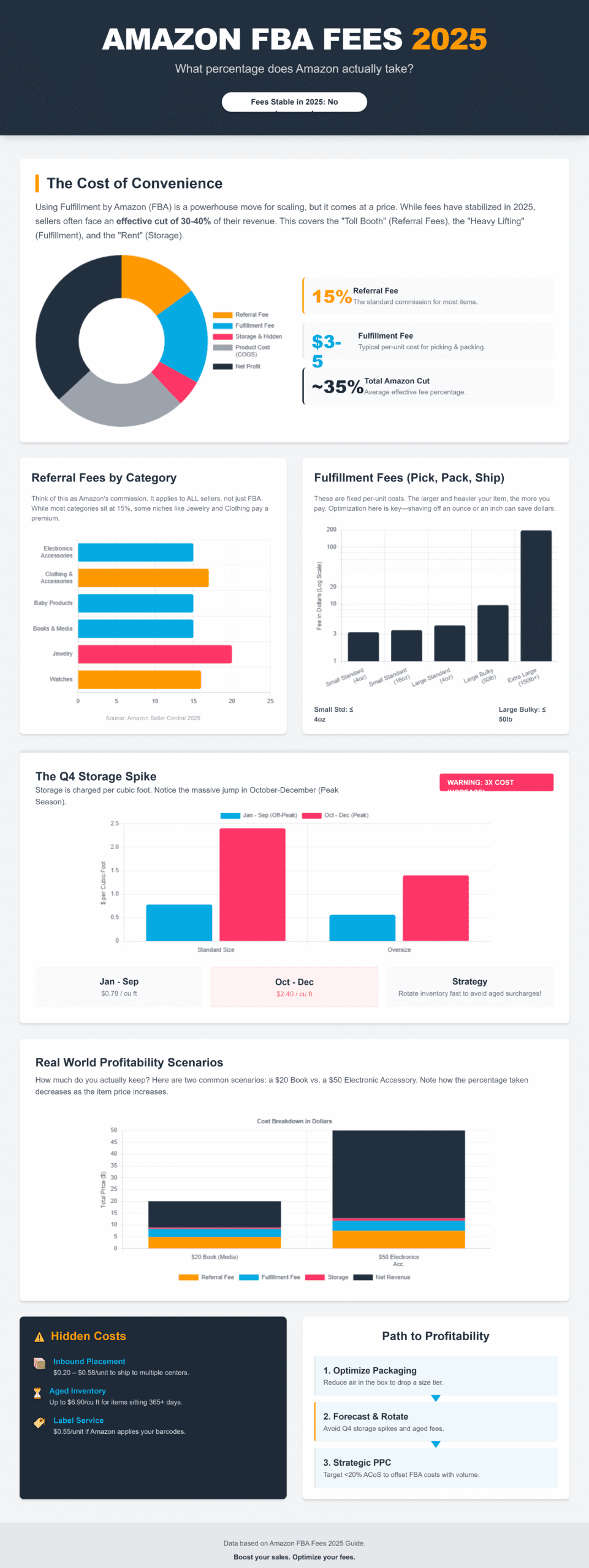
Amazon FBA isn’t just about convenience—it’s a powerhouse for scaling your business. But let’s be real: fees can sneak up on you if you’re not prepared. In 2025, Amazon kept fees stable from 2024, with no increases in referral or FBA rates. Typically, Amazon’s cut combines a 15% referral fee for most categories, plus per-unit fulfillment costs around $3–$5, and monthly storage averaging $0.50–$1 per cubic foot.
Picture this: You sell a $20 gadget. Amazon might take $3 in referral (15%), $3.50 in fulfillment, and a bit for storage—totaling about 30–40% effective cut. Scary? Nah, with innovative strategies, you can turn that into pure profit. Stick around as we break it down with tables, examples, and tips to optimize. Whether you’re voice-searching “how much does Amazon FBA cost,” or just curious, this guide’s got you covered.
Understanding Amazon FBA Fees Basics
Amazon FBA, or Fulfillment by Amazon, lets sellers store products in Amazon’s warehouses, where the giant handles picking, packing, shipping, and customer service. But what percentage does it take? It’s not a flat rate—it’s a mix of referral fees (percentage-based), fulfillment fees (per unit), and storage fees (volume-based). Entities like Amazon Seller Central provide tools to calculate these.
In 2025, fees remain unchanged from late 2024, offering stability amid economic shifts. LSI terms like Amazon seller fees, FBA cost calculator, and fulfillment charges help search engines connect your queries. For voice search like “Alexa, what fees does Amazon FBA charge?” expect answers focusing on these components.
Why care? High fees can eat 30–50% of revenue on low-margin items. But with planning, you minimize them. Let’s dive deeper.
Amazon Referral Fees Percentages
Referral fees are Amazon’s commission for using their platform, applied to all sellers—not just FBA. They’re the actual “percentage” part, ranging from 8% 45% based on category. For most, it’s 15%.
Here’s a table of key categories in 2025:
| Category | Referral Fee Percentage | Minimum Fee |
| Electronics Accessories | 15% up to $100, 8% over | $0.30 |
| Clothing & Accessories | 17% for >$20 | $0.30 |
| Baby Products | 15% for >$10 | $0.30 |
| Books & Media | 15% + $1.80 closing | N/A |
| Everything Else | 15% | $0.30 |
| Jewelry | 20% up to $250, 5% over | $0.30 |
| Watches | 16% up to $1,500, 3% over | $0.30 |
Source: Amazon Seller Central. Use this to pick profitable niches. For example, selling books? That extra closing fee adds up.
2025 FBA Fulfillment Fees Breakdown
Fulfillment fees cover the magic of FBA: picking, packing, and shipping. They’re fixed per unit, not percentage, but contribute to your overall cut. In 2025, rates match 2024 non-peak, with peak surcharges October–December.
Table for standard non-apparel (low-price rates in parentheses for items <$10):
Size Tier Weight Fee (Standard)Fee (Low-Price)
| Size Tier | Weight | Fee (Standard) | Fee (Low-Price) |
| Small Standard | 4 oz or less | $3.22 | $2.50 |
| Small Standard | 12+ to 16 oz | $3.50 | $3.21 |
| Large Standard | 4 oz or less | $4.25 | $3.48 |
| Large Bulky | 0–50 lb | $9.61 + $0.38/lb over 1 lb | $8.84 + $0.38/lb over 1 lb |
| Extra-Large | 150+ lb | $194.95 + $0.19/lb over 151 lb | $194.18 + $0.19/lb over 151 lb |
Apparel fees are slightly higher, e.g., large standard 8–12 oz: $4.67. Practical example: A 10 oz t-shirt ($15 sale) incurs $4.25 fulfillment + 17% referral ($2.55) = ~45% total cut before storage.
Monthly Storage Fees in FBA
Storage isn’t a percentage but is charged per cubic foot monthly. It’s low but stacks up for slow-movers.
- Jan–Sep: $0.78/cu ft (standard), $0.56/cu ft (oversize)
- Oct–Dec: $2.40/cu ft (standard), $1.40/cu ft (oversize)
Example: A 1 cu ft box of gadgets stored year-round? About $10–15 annually per unit if averaged.
Tips to reduce storage costs:
- Rotate inventory fast to avoid aged surcharges (extra for 181+ days).
- Use Amazon’s tools for demand forecasting.
- Consider seasonal storage planning.
Other Hidden Amazon FBA Costs
Beyond basics, watch for:
- Inbound placement: $0.20–$0.58/unit for shipping to multiple centers (reduced in 2025 for bulky items).
- Returns processing: Free for some, but charged if customer-paid.
- Aged inventory: Up to $6.90/cu ft for 365+ days.
- Label service: $0.55/unit, optional.
These can add a 5–10% effective cut.
Total % Amazon FBA Takes: Examples.
No fixed percentage, but let’s calculate with examples.
Example 1: $20 book (media category)
- Referral: 15% ($3) + $1.80 closing
- Fulfillment: $3.50 (small standard)
- Storage: $0.50/month (assume 1 month)
- Total: ~$8.80, or 44%
Example 2: $50 electronics accessory
- Referral: 15% on $100 cap, but $7.50
- Fulfillment: $4.25
- Storage: $1
- Total: $12.75, or 25.5%
Quick tips:
- Low-price items: Use low-price FBA rates to save ~20%.
- High-volume: Economies scale down effective %.
- Tools: Amazon Revenue Calculator for precise math.
How PPC Works on Amazon
Amazon PPC (pay-per-click) isn’t a fee but an ad tool to drive sales, offsetting FBA costs. You bid on keywords, pay only when clicked, boosting visibility.
Tips:
- Set ACoS target <20% to profit.
- Use negative keywords to avoid waste.
Integrating PPC reduces the effective FBA % by increasing volume.
Tips to Reduce Amazon FBA Costs
- Choose low-fee categories like appliances (8%).
- Optimize packaging for smaller tiers.
- Forecast sales to minimize storage.
- Leverage promotions: 2025 extensions on pet/apparel referrals at 4.5% for FBA.
- Outsource to an Amazon PPC agency in the USA for ad efficiency.
Conclusion
Wrapping up, “What percentage does Amazon FBA take?” typically ranges from 20–40%, including 15% for referrals, $3–$5 for fulfillment, and storage. But it’s variable—use our tables and examples to crunch your numbers. In 2025, stable fees mean opportunity: Focus on high-margin products, efficient inventory, and smart PPC to keep more profits.
Don’t let fees deter you; many sellers hit $10K/month by mastering this. Ready to start? Head to Amazon Seller Central, plug in the Revenue Calculator, and launch your store. For pro help, consider a top Amazon PPC agency to manage ads and skyrocket sales. Your e-commerce empire awaits—take action today and sell smarter! “BoostXLLC also helps those who are on this journey .
FAQs
- What percentage does Amazon FBA take from sales? About 15% in referral fees plus fulfillment and storage, totaling 20–40% depending on product.
- How much are Amazon FBA fulfillment fees in 2025?
$2.50–$194+ per unit based on size/weight. - What are Amazon referral fees by category?
Mostly 15%, but varies: 17% for clothing, 8% for appliances. - How to calculate total Amazon FBA costs?
Add referral % + fulfillment per unit + storage per cu ft. - Can PPC help reduce the effective FBA percentage?
Yes, by boosting sales volume.